
A permanent marker strain is a gassy, loud hybrid cross built around a sharp chemical-sweet smell that hits before the jar even opens. Massachusetts shoppers have come to know it for strong lab numbers, with THC results that often land on the higher end of what adult-use menus carry. This is adult-use information meant for shoppers 21 and older, and any purchase requires a valid government ID showing proof of age.
Table of Contents
What’s Behind the Permanent Marker Name
Permanent Marker traces back to Biscotti, a cookie-leaning line known for thick, gas-forward smells that run through a lot of modern hybrids. Breeders paired it with other heavy-hitting genetics to push that fuel smell even further, which is why budtenders group it with the gassiest crosses on the shelf.
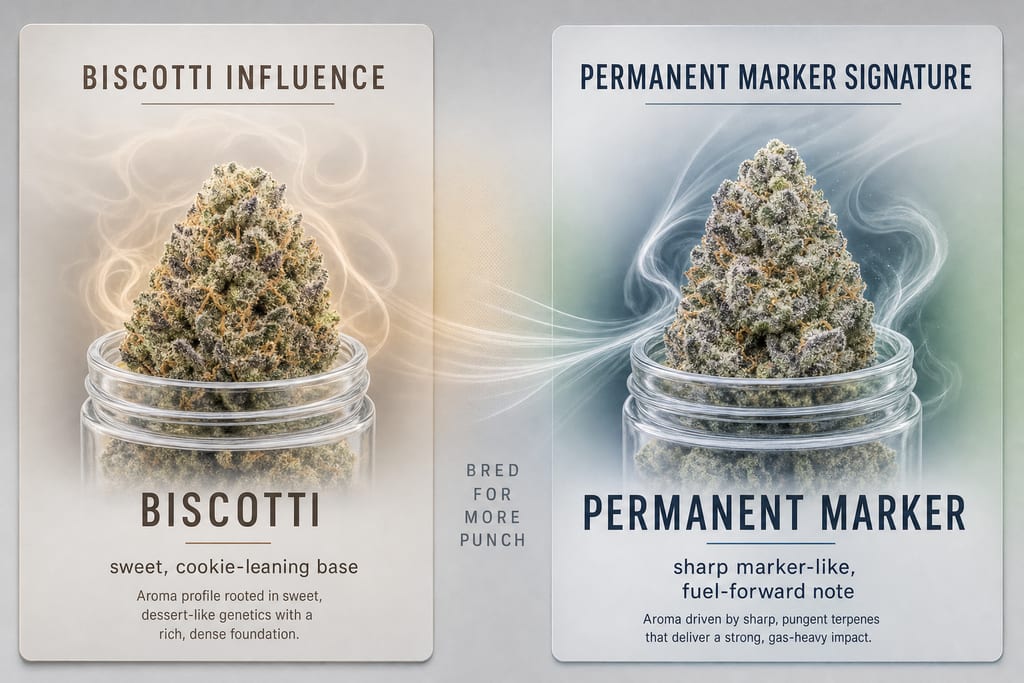
The name comes from the first smell most people notice, a sharp, chemical note close to a fresh marker cap. That note sits on top of the sweeter Biscotti base, so the jar can smell like fuel and dough at the same time.
| Trait | Detail |
|---|---|
| Lineage | Biscotti-based cross |
| Dominant terpene | Caryophyllene, gas-forward profile |
| Classification | Hybrid |
Exact genetics and lab numbers shift from grower to grower and batch to batch, since each cultivator selects phenotypes a little differently. A budtender can walk a shopper through the lab sheet for whatever batch is on the shelf that day.
Why Permanent Marker Smells So Loud
Shoppers describe the smell as chemical, gassy, and slightly sweet, close to a dry-erase marker left uncapped on a desk. That sharp note comes from caryophyllene and limonene, two terpenes that show up again and again on lab sheets for this cross. Caryophyllene brings the peppery, fuel-like edge, while limonene adds a citrus lift underneath the gas.
The Scented Marker phenotype leans into this even harder than a standard cut, which is why it carries the name on the label. Smell intensity can shift jar to jar depending on how the batch was cured and when it was harvested, so one eighth might read louder than the next even from the same grower.
- Chemical, marker-cap top note
- Sweet Biscotti base underneath
- Caryophyllene for the peppery gas edge
- Limonene for a citrus lift
A budtender at the counter can open a jar so a shopper gets a direct nose check before buying.
What Effects Adults Commonly Report
Adults who use this hybrid often describe a heavy-feeling body sensation paired with a relaxed head space. Because it sits as a hybrid cross rather than a straight indica or sativa, the balance between body and head can lean a different direction depending on the person using it.
Response depends on a few practical factors more than the strain name alone:
- Personal tolerance built up over time
- Product format, flower versus pre-roll versus other options
- Setting, whether it’s a quiet evening or a social one
- Body chemistry, which differs person to person
No two people will report the exact same experience, and this page does not give dosing guidance of any kind. A budtender can talk through format and strength so a shopper picks something that fits what they’re looking for that day.
Want to see our menu?
THC Numbers Across These Permanent Marker Products
Kush Groove carries three Permanent Marker products, and each one covers a different size and price point. The Perpetual Scented Marker #10 comes as a 1g pre-roll at $6, built for a single session without committing to a full jar.
| Product | Size | Price |
|---|---|---|
| Perpetual Scented Marker #10 | 1g pre-roll | $6 |
| Perpetual Scented Marker | 3.5g eighth | $20 |
| Old Pal Pineapple Frez x Permanent Marker | 14g half | $60 |
The Perpetual Scented Marker 3.5g eighth runs $20 and works as a standard flower purchase for regular use. The Old Pal Pineapple Frez x Permanent Marker 14g half runs $60 for a larger stock-up.
- $6 pre-roll for one session
- $20 eighth for normal rotation
- $60 half-ounce for a bigger supply
THC percentages vary by batch, so the number printed on one jar’s label won’t match the next, even for the same product name. Staff can pull the current lab result for whichever batch is on the shelf.
Picking A Format That Fits How You Use It
Format choice usually comes down to how familiar a shopper already is with the strain, not the effects themselves. Someone trying Permanent Marker for the first time can grab the $6 pre-roll instead of committing to a full jar they might not finish.
The 3.5g eighth at $20 fits someone who already knows they like it and wants it in regular rotation without a big upfront cost. The 14g Old Pal half at $60 suits adults who’ve settled on this profile as a go-to and want more on hand.
- Pre-roll, $6, for a first try
- Eighth, $20, for steady rotation
- Half-ounce, $60, for a known favorite
The Old Pal cross adds a fruitier Pineapple Frez note layered over the classic gas smell, which gives it a slightly different character than the straight Perpetual cuts. That fruit note is specific to the Pineapple Frez cross and won’t show up in the standard Scented Marker jars.
Which Size Actually Fits Your Situation
Three shoppers walk in with three different goals, and the size that fits one of them is wrong for the other two. Someone who has never smelled a permanent marker strain before has no business buying a half ounce. Someone who already knows the profile and wants a bigger supply is wasting a trip buying single pre-rolls every week.
The trade-off is simple: smaller formats cost less per trip but cost more per gram, while bigger formats cost less per gram but ask for money upfront on a smell and effect you might not like.
| Shopper type | Best fit | Downside |
|---|---|---|
| First-timer, unsure on the gas smell | $6 pre-roll | Highest cost per gram |
| Regular user, settled rotation | $20 eighth | Bigger upfront cost than a single pre-roll |
| Known fan, wants fruitier Pineapple Frez note | $60 half | Wrong choice if you haven’t tried the profile yet |
A shopper who hates the chemical-sweet smell after one pre-roll has lost $6, not $60. That’s the whole argument for starting small on a cross this specific in aroma.
Budtenders at either Kush Groove location, 701 Mount Auburn Street in Cambridge or 912 Crescent Street in Brockton, can pull up the current batch and talk through what’s on the shelf that day before you decide on size.
Ready To Pick Up A Jar In Person
Stop by Kush Groove in Cambridge at 701 Mount Auburn Street or in Brockton at 912 Crescent Street, and bring a valid government ID showing you’re 21 or older, since no purchase gets made without one. Ask whichever budtender is on the floor for the current batch’s lab sheet and what formats are stocked that day, since shelf stock shifts week to week. All purchases happen in person, or through local pickup or delivery where Massachusetts rules allow it, so plan your visit rather than looking for shipping options.
Common Questions About Permanent Marker
Is Permanent Marker the same as Scented Marker, or are they different strains?
Scented Marker is a phenotype of Permanent Marker, not a separate strain. Growers select certain cuts of the same genetic line because they lean even harder into the gas-forward smell, and those cuts get labeled Scented Marker on the jar. Both trace back to the same Biscotti-based lineage described above.
Can the smell from this strain linger on clothes or in a car?
Yes, strong gas-forward smells like this one can cling to fabric, hair, and closed spaces such as a car interior. The chemical-sweet profile that makes this cross easy to pick out in a jar is the same reason it sticks around after the fact. Cracking a window or airing out fabric afterward cuts down on how long it hangs around.
What should I ask my budtender before choosing between the pre-roll and the eighth?
Ask what batch is currently stocked and whether the lab sheet for that batch is available to look at. A budtender at either Kush Groove location can also tell you how that specific batch has been curing and whether shoppers have reported it running stronger or milder than past drops. That gives you a clearer picture than the product name alone.
Does the Old Pal cross cost more per gram than the straight Perpetual flower?
No, the Old Pal half actually runs cheaper per gram than either Perpetual size. At $60 for 14 grams it works out to a little over $4 a gram, compared to roughly $5.71 a gram for the eighth and $6 a gram for the pre-roll. The trade-off is the larger upfront cost, not the per-gram price.